Growing up, I’d sit with my dad as he watched the evening news to see how his tv news competitors were doing. The local Fox broadcast was at 9pm, easy enough, but the rest were all at 10. The result was a nightly frenzy as he’d try to watch all of these simultaneously. On some nights, I was in control of the channel hopping. My deputization was one I took extremely seriously, and it required tantamount focus. “CHANNEL 5! CHANNEL 7! CHANNEL 2!” The TV could hardly keep up, his commentary ripping over top “They’re leading with the pope?”, “This guy isn’t very good”, “wrong graphic”, etc. I was baptized in the fiery world of Bush-era television news during my youth.
If you watch enough television news, you’ll start to notice very clear cycles in what they choose to cover. Obviously, politics is overwhelming. Each time I find myself glancing at a tv with the invariable “breaking news:” banner followed by a politician speaking words that exactly no one would ever describe as ‘breaking’ or often even ‘news’, I cringe. But when I say cycles, I mean outside of the conveyor belt of political slop – the other news. Weather, traffic, technological developments, celebrity scandals, war, a feel good story or two, you know the mix. After years of staring at chyrons, you’ll start to recognize topics that every so often will recur. Topics that seem to spark some bedrock fear in us, and that resultantly have a renaissance in the news every so often. Watching in recent years, I’ve seen one of our old comets make its way back: plane crashes.
Since we’ve had passenger flights, we’ve had headline stories about them crashing down. When someone truly fears these, it’s a powerful one. The lack of control, violence, and fear of one’s final moments being a self aware terror outweigh any snide statistics about how safe flying is. You’d be mistaken looking at the news to think that we’re in an era of plane crashes. It’s not that flying is marginally safer than last century, it is massively safer. Way, way safer. During the latter half of the 20th century1 in the US alone, you could expect to see a major plane crash every few months. Between 2009 and 2025 there were zero major plane crashes.

As mentioned, this data doesn’t make anyone feel better about anything. Growing up I would watch Air Crash Investigations, a show dramatizing hundreds of plane crashes and their subsequent investigations. It’s a deceptively popular show amongst the nerd population of the 2000’s. The shot/chaser of watching the campy and at times downright disrespectful2 reenactments of plane crashes followed by the payoff of explaining how it happened piece by piece scratches a neurotic technical itch for me. The vivid fear and drama of it is all way too juicy for a young me to resist, and the knowledge that it’s based in reality gave it gravity.
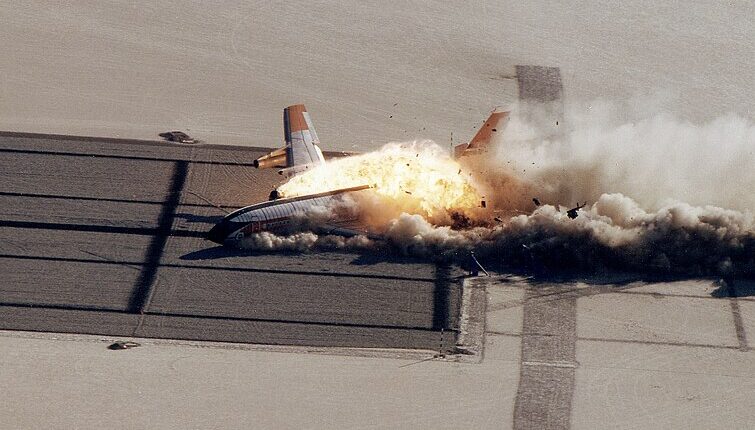
The trouble historically has been that typically the news media and documentarists could only get film after the fact. The B-roll of a smoldering field, or debris in the water was the best they could do. In a few ‘lucky’ cases, there’d be more. Those cases captured the public. The dramatic film of the burning Hindenburg in 1936 kicked this off, with many visiting theatres to see it. My dad as a young newsman in 1970’s Chicago remembers covering American Flight 191 crashing just after take off from O’hare, its left engine detaching and flipping clear over the wing. In that case, a single shot from the airport shows the plane in a doomed flip. A rare moment of action that was published just about everywhere at the time.

Exceptions aside, most of the coverage since then has been aided with increasingly complex visualization so viewers can see just how terrifying what happened really was. Air crash investigation has many of these, they are the backbone of the program. Then, the late 2000’s passed. We were so focused on CDOs, the Lakers, and Obama wearing a tan suit that the fact that planes were no longer falling out of the sky didn’t seem to register on a cultural level. To be clear – this was still happening abroad, but significantly less so there as well. In production rooms across the nation, coverage of plane crashes naturally became minimal.
When two Boeing planes crashed in Ethiopia and Indonesia in the late 2010s, American attention was far more focused on the preventable failure of Boeing than the carnage and human effect. Then it all came back. In a few short years, plane crashes returned to coverage. At first it was almost absurdist. When an Alaska Airlines flight blew a door out in early 2024, jokes abounded online about the issue having happened on a Boeing plane. Gradually, the tone changed. In our unusually long cultural hiatus, old and new truths lurked in the background:
1. At the scale and complexity of global aviation, some crashes are likely. This has been true since the advent of trans-atlantic mass aviation in the 1950’s.
2. The new one: everyone has a smartphone, and those now have pretty good cameras.
On December 29 2024, an Air Jeju flight in South Korea impacted some birds, attempted an emergency landing with the gear retracted, and slid into a concrete wall, killing 179 of 181 aboard. Unlike blurred photos and early animations of past disasters, it was all on video. That video was just about everywhere in an instant.
One month to the day later America’s first major aviation accident in 15 years as AA5342 hits a military blackhawk that had deviated course and both crash into the potomac. Also on video, also unavoidable on all kinds of media. By now, a certain fervor had taken hold. Relatively minor aviation incidents like engine flameouts and bird strikes became circulated, usually on video. Smaller plane crashes became instant national news, like a small plane crash in Philadelphia just two days later (caught on video). The plane crash news cycle renaissance had begun, this time bolstered by film quality video of seemingly every event.
A few months later, Air India flight 171 took off briefly before crashing down in Ahmedabad killing 241/242 aboard. By this point you already know, it was captured on video. Watching the percussive and self-reinforcing fear circulate has been a bit surreal. After so many years of dormancy, we don’t need to imagine what these events are really like between the lines of a poor CNN animation, we can watch them outright. Gone are the days of burning piles and perhaps a single picture. It’s truly horrific.
I have a prevailing guilt with this stuff. I’m deeply curious about the intimate details of these crashes. That curiosity is emotional and technological, in the same way as when I was watching VHS recordings of air crash investigations as a kid. So I watch the videos, I don’t miss them. But it reaches a point of vividness that starts to get sickening. Being able to see the light pass through the cabin windows of the Jeju air light as it passes the camera in its final seconds, or seeing the pilots of AA5342 try to pull the plane up at the last second is just crushing and humanizing in a way that bulky 1997 animations of TWA 800 I saw on my square television weren’t. It feels like I’m not supposed to see this. I’d like to stop, but I don’t think I’m likely to.
This horror and guilt are good things. The natural distance of receiving the world’s events via a screen makes it all feel like a TV Show, reasonable to view dispassionately as I did those chunky animations. In Susan Sontag’s Regarding the Pain of Others, she notes that “Compassion is an unstable emotion. It needs to be translated into action, or it withers. The question of what to do with the feelings that have been aroused, the knowledge that has been communicated… If one feels that there is nothing ‘we’ can do—but who is that ‘we’?—and nothing ‘they’ can do either—and who are ‘they’?—then one starts to get bored, cynical, apathetic.”
There’s little you and I can do about plane crashes. What we can do is take on the task of parsing the news through empathy for the lives affected, and in that effort we’ll find our compassion. These videos are sobering in the way it all should be, and that’s a weirdly good thing. I’m glad for it. Safe travels.
Colin